Showing posts with label Folklore. Show all posts

Saturday, October 29, 2016

Stone Soup

Image result for stone soup folktale


Stone Soup
By: Ann McGovern

Publisher: Scholastic Paperbacks
Copyright date: 1968
Pages: 32
Genre: Folklore
Grade Level: K-3rd

Summary: A poor young man tricks an old lady into making him soup. When he asks her for food she claims to have none. He then asks for a stone and the woman is confused. Why would he want a stone? He tells her that you can make an incredible stone soup with the stone. He has her add more and more ingredients to the pot of boiling water with the stone until it just right. 

Classroom use: This book could be used to practice reading comprehension and sequencing. After reading the book you can have students cut out a big pot and all of the ingredients that were put into the soup. They can then number them and paste the ingredients on their pot in the order they were used in the story. 

Rating: 


***
**
*
-
Comments
Plot
Plot is well developed with a sequence of events. The events are in good logical order. There is a clear conflict and resolution.
Plot contains a sequence of events. The events are in order but the conflict is not clear or does not contain a clear resolution.
There are events but they are not in good chronological order. The climax and resolution are lacking or not present.
Not addressed
*** The plot is well developed. There is a clear sequence of events which are in good logical order.
Characters
Characters are well developed with clear roles and contribute to the story. Reader is able to personally connect with the character(s).
Characters have clear roles within the story. Reader is not able to connect with the character(s).
Character(s) are present but do not have clear roles. Reader is not able to connect with character(s).
No characters developed
*** The characters are well developed. Each is different giving the reader two options of characters to connect with.
Style and Language
Book contains precise vocabulary, figurative language, and or dialogue. When dialogue is used it is effective and not distracting.
Book contains precise vocabulary and/or figurative language. When dialogue is used it is distracting.
Book contains very little precise vocabulary and no figurative language or dialogue.
Book contains no precise vocabulary or figurative language. No dialogue is used.
*** Language used in the book is effective. Dialogue contributes to the story and makes it more interesting.
Theme
There is a clear theme and it is easily identifiable by the story.
There is a theme but it is a little more difficult to identify.
The theme is almost impossible to identify.
There is no theme.
*** There is a clear theme that can be taken from this book.  


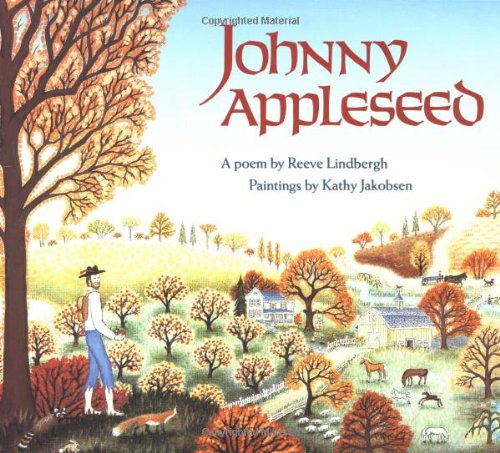
Johnny Appleseed

Image result for johnny appleseed children's book Reeve Lindbergh

Johnny Appleseed 
By: Reeve Lindbergh

Publisher: Little Brown Books for Young Readers
Copyright Date: 1990
Pages: 32
Genre: Folklore
Grade Level: 1st-4th

Summary: This is a story of John Chapman, also known as Johnny Appleseed, a man who planted apple seeds to grow apple trees all across the land. In this story he leaves seeds with a family, of a town he is passing through, and they plant them. The seeds grow into apple trees and when John makes his way back through the town the family thanks him for the abundance of apples that the trees have given them.


Classroom use: This book would be a great addition to a social studies lesson/ geography lesson. You could read the book together as a class and track his movements across the country marking every state off on a map that he went to and planted apple seeds. The kids could see his path and relate it to the story and also learn the location of different states.  

Rating:

***
**
*
-
Comments
Plot
Plot is well developed with a sequence of events. The events are in good logical order. There is a clear conflict and resolution.
Plot contains a sequence of events. The events are in order but the conflict is not clear or does not contain a clear resolution.
There are events but they are not in good chronological order. The climax and resolution are lacking or not present.
Not addressed
*** There is a well developed plot which contains a sequence of events that are in good logical order.
Characters
Characters are well developed with clear roles and contribute to the story. Reader is able to personally connect with the character(s).
Characters have clear roles within the story. Reader is not able to connect with the character(s).
Character(s) are present but do not have clear roles. Reader is not able to connect with character(s).
No characters developed
*** The main character is well developed and readers are able to connect.
Style and Language
Book contains precise vocabulary, figurative language, and or dialogue. When dialogue is used it is effective and not distracting.
Book contains precise vocabulary and/or figurative language. When dialogue is used it is distracting.
Book contains very little precise vocabulary and no figurative language or dialogue.
Book contains no precise vocabulary or figurative language. No dialogue is used.
*** Language used in the book is effective with a great use of imagery. It contains poetic text which flows nicely.
Theme
There is a clear theme and it is easily identifiable by the story.
There is a theme but it is a little more difficult to identify.
The theme is almost impossible to identify.
There is no theme.
** There are a few themes that can be taken from this book rather than one clear theme.